
Dr. Joseph Fournier | Senior Scientist

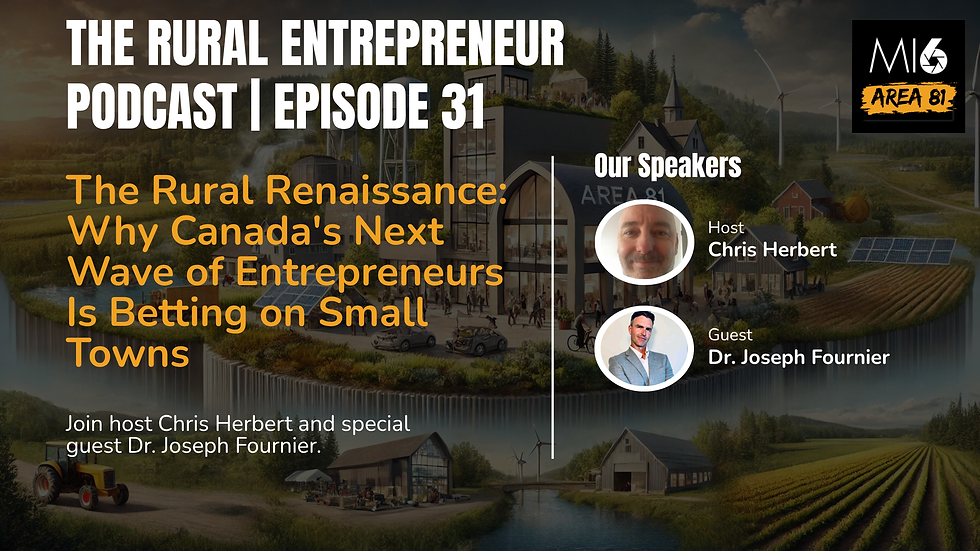
The Rural Renaissance: Why Canada's Next Wave of Entrepreneurs Is Betting on Small Towns
Most people spend their careers moving toward the city. Dr. Joseph Fournier did the opposite — on purpose — and then built a body of research to explain why that bet makes sense.
In Episode 31 of the Rural Entrepreneur Podcast, we sat down with Dr. Joseph Fournier: a former oil and gas executive and research scientist who traded downtown Calgary for a sheep ranch a hundred kilometres east of the city, and who now writes as a Senior Fellow at the Frontier Centre for Public Policy. His "Rural Renaissance" white paper — currently under peer review — argues that small-town and rural Canada isn't a place people retreat to. It's where the next decade of economic opportunity is being built.
If you're a rural entrepreneur, this conversation reframes the ground you're already standing on.
TL;DR
Since 2019, hundreds of thousands of Canadians have moved out of the big cities — and Fournier argues it's the start of a structural shift, not a blip. The Rural Renaissance has two halves: a hard-nosed case for economic sovereignty, and a hopeful case for cultural and economic renewal in small towns. For entrepreneurs, the signal is clear:
Migration is reversing — lockdowns, remote work, a home-equity surge, and AI are pushing people out of the metros
The trades win on mobility — blue-collar paths reach self-employment faster than white-collar ones, and the work sits closer to rural communities
Density has a health cost — fewer daily stranger interactions, less noise and light pollution, measurably better mental health
Rural holds what cities can't copy — cheap land and clean airsheds make small communities ripe for industry, agriculture, and energy
One skill decides it — you have to learn to sell yourself
The question every aspiring entrepreneur should sit with: what can I build where I am that a city can't replicate?
What's Covered in This Post
Use the links to jump to each section.
Hundreds of Thousands Are Moving the Other Way
For forty years, the story ran one direction: talent flows to the city. Fournier's research says that story broke around 2019.
Since then, he points to a historic shift in migration — hundreds of thousands of Canadians flowing out of major metros like Toronto, Montreal, Vancouver, and Calgary, and into smaller communities and the exurbs beyond them.
That's not a lifestyle anecdote. It's the leading edge of what Fournier calls the Rural Renaissance, and he believes the entrepreneurs who understand why it's happening are the ones best positioned to build on it.
Dr. Joseph Fournier. From Calgary Executive to Sheep Rancher
The gist: Fournier left the "golden handcuffs" of an energy-sector executive role for a ranch he could afford — trading income for autonomy, and gaining the freedom to build on his own terms.
Fournier's story starts where a lot of professional-burnout stories do: a downtown office, a long commute, and a creeping sense that the work wasn't worth the trade. He and his wife were research scientists and executives in Calgary's energy sector, losing roughly 90 minutes a day to gridlock and watching a once-promising industry contract around them.
Around 2017, they bought a place about a hundred kilometres east of Calgary — a coulee with a creek and a yard of hundred-year-old trees the original pioneers had the foresight to plant. Eight years later, Fournier runs a hobby sheep ranch built around winter lambing, deliberately producing lamb in the off-season so he can sell when prices peak. He raises his own pork and chicken and does his own butchering.
He now splits his time roughly fifty-fifty between ranching and writing — around 160 op-eds across outlets like the Western Standard, Epoch Times, and National Post, plus a Senior Fellowship at the Frontier Centre for Public Policy. When they offered him a salary, he asked to be paid per project instead. The thing he values most now isn't income. It's freedom — and that tension sits at the heart of the whole rural entrepreneurship story.
What the "Rural Renaissance" Really Means
The gist: The thesis has two halves — a strategic case for Canadian sovereignty and supply-chain resilience, and a hopeful case for cultural and economic renewal. Entrepreneurs live in the second half.
Fournier frames his thesis in two parts.
The first is geopolitical and strategic: the argument that Canada needs to be able to make things again — to refine its own critical minerals, manufacture its own essentials, and stop routing supply chains through volatile maritime choke points like the Strait of Hormuz and the South China Sea. It's the sober half of the paper.
The second is the hopeful half: cultural renewal and economic resurgence. It's the argument that small towns are where opportunity, resilience, and self-employment are converging — and it's where rural entrepreneurs come in.
Why Canadians Are Leaving the Cities
The gist: Four forces stacked up in sequence — lockdowns, a home-equity windfall, the rise of AI, and urban quality-of-life decline — and together they reversed a forty-year migration pattern.
Fournier describes the exodus as a chronological domino effect:
The lockdowns and remote work. Two years of working from home normalized hybrid roles and untethered a lot of people from the office entirely.
The home-equity surge. Urban homeowners watched their equity jump dramatically, then realized they could cash it in for land and space in a smaller town — often putting 50% down on a house an hour out.
The rise of AI. White-collar work is being compressed: as Fournier puts it, one engineer can now do the work of three, and coding roles in particular are thinning. The trades aren't being hollowed out the same way.
Urban quality of life. Rising homelessness, the opioid crisis, and climbing crime rates — heavily concentrated in the major metros — are pushing families to look elsewhere.
The result is a steady outflow of people who want something different, and the data (through 2024) backs it up.
The Blue-Collar Advantage
The gist: Vocational mobility — how fast you can become your own boss — favours the trades. A welder can go independent in roughly five years; an engineer might need fifteen.
One of the most useful ideas in the conversation is vocational mobility: how quickly you can move up and ultimately work for yourself.
Fournier argues blue-collar paths offer far more of it. A welder with a Red Seal can move across provinces coast-to-coast almost immediately and start their own business in maybe five years. A lawyer has to re-license province by province; an engineer might need fifteen years of experience and contacts before launching a consultancy. And the pay is real — skilled welders earning $150,000 to $200,000 a year is not unusual.
Critically, those opportunities are concentrated in smaller cities and rural communities, not downtown towers. For a rural entrepreneur, that's the whole point: the demand is closer to home than the urban narrative admits.
For rural entrepreneurs: Mi6's AREA 81 was built for exactly this moment — a network of peers for people building ventures outside the big city.
The Mental Health Dividend
The gist: "Stocking density" — the number of daily interactions with strangers — has a documented effect on mental health. Lower density, quieter soundscapes, and darker skies measurably help.
Fournier borrows a ranching term — stocking density — to describe something the psychiatric literature has long documented: humans have an optimal number of daily interactions with strangers before it tips into a stressor. Move to lower density, and rates of severe mental health disorders tend to decline.
Subscribe: Dr. Joseph Fournier's Substack
Add quieter soundscapes and darker skies, and you get an environment where, as he describes it, you can suddenly hear a chickadee and see the stars. It isn't nostalgia. It's a well-established benefit that's pulling families toward quieter places — and a genuine selling point for the communities competing to attract them.
The Opportunity Cities Can't Replicate
The gist: Cheap land, clean airsheds, and a higher share of skilled trades make rural regions uniquely suited to industry, agriculture, and energy — advantages that can't be rebuilt downtown.
Here's where the message turns directly entrepreneurial. Rural regions hold structural advantages a major city simply can't reproduce:
Cheaper land to build on.
Cleaner airsheds with far fewer existing emission sources — which matters enormously for any heavy industry that needs environmental headroom.
A higher proportion of skilled blue-collar workers in the local workforce.
That combination makes smaller communities ripe for investment in mining, mineral refining, petrochemicals, and advanced manufacturing — the "machines of industry" you can't easily put next to Toronto. Fournier sees agriculture and energy as foundational industries with room to evolve, from premium farming to new revenue streams layered onto existing operations.
He points to real signals already on the ground: a De Havilland aircraft facility being built near Strathmore, Alberta — a town of roughly 15,000 — expected to create around 750 jobs, most of them local. His one caution: migration alone isn't enough. Communities need jobs, not just commuters, so newcomers and multi-generation locals are building things together rather than simply living side by side.
The One Skill No Entrepreneur Can Skip
The gist: A skill and an idea aren't enough. The capability most aspiring entrepreneurs neglect is sales — the ability to sell yourself — and it's trainable.
We closed by asking Fournier what advice he'd give someone weighing self-employment. His answer was refreshingly blunt: a skill and an idea probably won't be enough.
The thing most people neglect is sales — the ability to sell yourself. Fournier admits it's the muscle he's had to build late, having spent a career where headhunters came to him. His prescription: invest in it deliberately. Learn public speaking. Practice talking. Record yourself. Treat self-promotion as an essential, trainable skill, not an optional one.
For a rural entrepreneur, where word of mouth and relationships carry so much weight, that advice lands especially hard.
What This Means for Rural Entrepreneurs
Step back and the picture is clearer than any single headline. For forty years we were told the service economy and the white-collar career were the only paths forward — and Fournier argues that era is ending.
The "national psychological rewiring" he describes isn't a step backward. It's a recognition that resilience, self-employment, and the ability to build things again all point toward the same place: rural and small-town Canada.
That's the bet a lot of our listeners have already made. According to Fournier's research, it may turn out to be one of the smartest ones — and the entrepreneurs who can name what they own that a city can't replicate are the ones who'll compound the most value from it.
Key Takeaways
Migration has reversed. Since 2019, hundreds of thousands of Canadians have left the major metros for smaller communities — a structural shift, not a pandemic blip.
The trades offer faster independence. Blue-collar vocational mobility outpaces white-collar, and the opportunities sit closer to rural communities.
Density carries a health cost. Lower "stocking density," less noise, and darker skies deliver real, documented mental-health benefits.
Rural advantages can't be copied downtown. Cheap land and clean airsheds make small communities ripe for industry, agriculture, and energy.
Sales is the non-negotiable skill. The ability to sell yourself is what turns a skill and an idea into a business.
The one question to ask: what can I build where I am that a city can't replicate?
Listen to the Full Episode
The summary above is the condensed version. Dr. Joseph Fournier's full conversation goes deeper on the white paper, the geopolitics of resilience, and the lived reality of trading an executive career for a ranch.
🎧 Listen to more Rural Entrepreneur Podcast episodes on Spotify — listen here.
Frequently Asked Questions
What is the Rural Renaissance?
The Rural Renaissance is the thesis — developed by rancher and policy researcher Dr. Joseph Fournier — that small-town and rural Canada is entering a period of economic and cultural resurgence. It has two sides: a strategic case for national resilience and the ability to "make things again," and a hopeful case for renewed self-employment, healthier living, and local opportunity as Canadians migrate out of major cities.
Why are Canadians moving from cities to rural areas?
Fournier points to four stacked forces since 2019: pandemic lockdowns that normalized remote work, a surge in urban home equity that let people cash out and relocate, the rise of AI compressing white-collar jobs, and declining quality of life in major metros. Together they reversed a roughly forty-year migration pattern toward the cities.
Are the skilled trades a better opportunity than white-collar careers now?
Fournier argues the trades offer greater "vocational mobility" — how quickly you can advance and become self-employed. A welder with a Red Seal can work coast-to-coast almost immediately and go independent in around five years, versus far longer for many white-collar paths, while AI is reducing demand for some office roles. The trades also concentrate in smaller cities and rural communities.
What are the mental health benefits of living in a rural area?
Drawing on a ranching concept he calls "stocking density," Fournier notes that humans have an optimal number of daily interactions with strangers before it becomes a stressor. Lower-density living, quieter soundscapes, and less light pollution are associated in the literature with lower rates of severe mental health disorders.
What kinds of businesses have an advantage in rural Canada?
Industries that benefit from cheap land and clean airsheds — mining, mineral refining, petrochemicals, and advanced manufacturing — along with agriculture and energy. Fournier sees these as foundational sectors with room to innovate, especially where new revenue streams can be layered onto existing operations.
What's the most important skill for someone who wants to be self-employed?
Sales — specifically, the ability to sell yourself. Fournier considers it the most commonly neglected skill among aspiring entrepreneurs and a trainable one: practise public speaking, record yourself, and treat self-promotion as essential rather than optional.
About This Article
Source: This article is based on a conversation with Dr. Joseph Fournier on Episode 31 of the Rural Entrepreneur Podcast. Fournier is a rancher and a Senior Fellow at the Frontier Centre for Public Policy; his "Rural Renaissance" white paper is currently under peer review. The episode is available on Spotify (linked above), and the framing and claims here are attributed to Fournier.
Published by: Jarvis and Chris — the cofounders of Mi6 Agency. We're a Canadian Venture Design Studio and a Rural Entrepreneur Accelerator helping entrepreneurs build businesses that work — with or without them.
Topics covered: rural renaissance, rural entrepreneurship, rural migration, skilled trades, vocational mobility, self-employment, agriculture, energy, mental health, Canadian economy, economic sovereignty, supply-chain resilience


Comments